How Play-Based Learning Can Make Education More Inclusive

Many children are asked to learn in ways that do not fit them. They sit still when they need to move. They answer in words when they think in pictures. Play-based learning can make education more inclusive. They learn by building, acting, sorting, testing, or repeating.
Play changes the entry point. It gives children more than one way to join in, show thinking, and build confidence.
Play-based learning is not a break from serious learning. It is a route into reading, maths, science, language, self-regulation, and friendship. It can also remove barriers for children with different needs, languages, cultures, ages, and learning profiles.

Play gives children more ways into learning.
A worksheet has one main route. Read the instruction. Write the answer. Sit in one place. Finish at the same pace as others.
That works for some children. It shuts out others.
A play-based task can offer several routes at once. A child can:
build a model
act out an idea
speak, sign, draw, point, or arrange objects
work alone first, then with a partner
repeat the same action until it makes sense
use movement to think
A child who struggles to write a sentence about a story may retell it with puppets. A child who finds number symbols hard may understand quantity by sharing toy food between plates. A child learning English may join a game through gesture before they have the words.
That is the power of inclusive play-based learning. It does not lower expectations. It widens access.
The goal stays clear. The path becomes flexible.
Inclusion starts with belonging.
Inclusion here means more than being in the same room. It means each child has a real role.
Play helps because it creates natural roles. In a pretend shop, one child may count coins. Another may make signs. Another may stock shelves. Another may greet customers. These roles can change. They can also be adapted.
A child with limited speech can scan items, point to pictures, stamp receipts, or use a communication board. A child who finds noise hard can run the delivery area away from the busiest part of the game. A child who needs movement can fetch goods, carry baskets, or act as the driver.
No one needs to be removed from the shared experience.
This sense of belonging often comes before academic risk-taking. Children try harder when they feel safe. They speak more when they feel understood. They stay longer with a challenge when they feel they have a role.
Play builds that safety when adults plan it with care.
Play-based learning supports children with different learning needs. can still explore colour, pattern, and mark-making
Inclusive education often fails when it asks children to adapt to one narrow method. Play lets the method adapt to the child.
Children who need movement
Some children think better when their bodies are active. Sitting still can take so much effort that they have little energy to learn.
Play can build movement into the task:
jumping along a number line
hunting for letter sounds around the room
acting out a lifecycle
using large blocks to build shapes
moving between stations to sort objects
The movement is not a reward after learning. It is part of the learning.
Children who need sensory support
Children may seek or avoid sensory input. Bright lights, loud noise, scratchy materials, or strong smells can affect attention and mood.
Play areas can offer choice:
quiet corners with soft materials
firm cushions or floor seating
trays with dry, wet, smooth, or crunchy textures
tools for touching materials without direct contact
clear boundaries for messy play
Choice reduces pressure. It also helps children learn what supports them.
A child who dislikes finger paint might start with a brush, sponge, or rolling tool. They learn.. They do not have to force direct touch before they are ready.
Children who use communication support
Play gives a strong reason to communicate. Children ask, refuse, choose, invite, explain, joke, repair problems, and negotiate roles.
Adults can add simple supports:
visual choice boards
now and next cards
signs and gestures
symbols for key words
repeated phrases in songs and games
props that make meaning clear
For example, a train track game can include cards for “stop”, “go”, “more”, “finished”, “fast”, and “slow”. A child can use speech, signs, pointing, or eye gaze. The communication counts.
That builds real participation.

Play helps children learn English.
A child who is new to English may know a lot but be unable to show it through classroom talk or written tasks.
Play gives context. Context makes language easier to understand.
If children are playing café, words link to real actions. “Cup”, “pay”, “hot”, “more”, “sit”, and “please” all have meaning in the moment. The child can watch, copy, respond, and join in before speaking much.
Home languages can also be part of the play. Children can label shop items in more than one language, sing familiar songs, or teach peers key words. This does not slow English learning. It strengthens identity and keeps knowledge connected.
Good practice includes:
pairing spoken words with objects and actions
repeating key phrases during routines
accepting responses in different languages
inviting families to share songs, stories, labels, and games
giving enough wait time
Play also reduces the fear of mistakes. A child can try a word while pretending to be a shopkeeper, vet, builder, or explorer. The role gives cover. The stakes feel lower.
That can unlock participation.
Play can reflect different cultures and family lives.
Children notice what counts in a learning space. They notice the books, dolls, food, names, music, clothes, celebrations, and stories.
If play materials only show one way of living, some children feel invisible. Others learn a narrow view of the world.
Inclusive play spaces offer a wider set of materials:
dolls with varied skin tones and body types
play food from different cultures
fabrics, utensils, and objects linked to real family life
books showing different homes, families, and communities
small world figures with varied ages and abilities
dressing-up clothes that avoid stereotypes
This does not mean turning culture into a themed week. It means making everyday materials feel more truthful.
A home corner can include a range of cooking tools. A reading den can include dual-language books. A construction area can show homes, bridges, gardens, flats, farms, and places of worship. Small world play can include wheelchairs, walking frames, prams, buses, market stalls, and parks.
Children should see familiar life. They should also meet lives beyond their own.
That helps build respect from the start.
Play makes assessment fairer.
Adults often assess children through what they say or write. Those are useful forms of evidence, but they are not enough.
Play shows learning in action.
A child may not explain balance in words, yet adjusts blocks until a tower stands. Another may not write number sentences, yet shares twelve shells fairly between three toy animals. Another may not answer a direct question about feelings, yet comforts a puppet and explains what it needs.
These moments matter.
Useful assessment during play focuses on evidence such as:
how a child approaches a problem
what strategies they repeat or change
how they use language, signs, gesture, or tools
how they respond to others
what they understand without adult prompting
what support helps them take the next step
This gives a fuller picture of the child.
It also helps adults avoid unfair judgements. A child may perform poorly in a formal task because of anxiety, language, motor demands, or sensory load. In play, the same child may show strong reasoning, memory, creativity, or social understanding.
Assessment becomes more accurate when it includes more than one way to show learning.

Adult guidance makes the difference.
Free play has value. Children need time to choose, explore, repeat, and lead.
But inclusive play-based learning also needs skilled adults. An adult’s job isn't to control every move. It means noticing, supporting, extending, and protecting access.
Strong adult support often looks simple:
setting up materials that invite more than one response
watching before stepping in
naming what children are doing
adding useful vocabulary at the right moment
helping children solve conflicts
modelling turn-taking without taking over
adapting tools so more children can use them
making sure the same children do not always lead
The key is timing.
Too much adult talk can shut play down. Too little support can allow exclusion to grow. Some children may be left out, ignored, or stuck in the same role every day.
Adults can ask direct, useful questions:
Who has not joined yet?
What might help this child take part?
Is the task too open, too noisy, or too unclear?
Are the materials easy to reach and use?
Does every child have a way to communicate?
Are we valuing the learning, or only the final product?
Small changes can shift the whole experience.
The environment should invite choice.
The space layout can include or exclude before an adult says a word.
A good play space has clear areas, visible materials, and enough room to move. Children should know where things belong. They should also be able to make choices without needing constant adult permission.
This helps children who need structure. It also supports independence.
Consider these features:
Clear labels
Use pictures, words, symbols, or objects so children can find and return resources.
Low storage
Place everyday materials within reach so children can access and return them safely.
Open-ended materials
Use blocks, fabric, loose parts, boxes, tubes, and natural objects.
Flexible seating
Offer chairs, cushions, floor space, standing options, or wobble cushions where suitable.
Quiet spaces
Provide somewhere calmer for children who need a break from busy play.
Adapted tools
Offer chunky pencils, easy-grip scissors, tongs, scoops, timers, and visual prompts.
Open-ended materials are especially useful. A cardboard box can become a bus, cave, shop, bed, robot, or animal shelter. Because there is no single “right” use, more children can succeed.
That lowers fear of failure.
It also raises the level of thinking. Children plan, test, negotiate, change ideas, and solve problems.
Play supports social learning without forcing it.
Some children love group play. Others need time beside others before they are ready to join. Some prefer one trusted partner. Some need help reading facial expressions, tone, space, or turn-taking.
Play can support social growth when adults respect these differences.
Parallel play can be a valid step. A child building next to others is still observing, copying, and learning shared routines. They do not need to be pushed into group talk before they are ready.
Adults can create gentle bridges:
duplicate favourite resources to reduce conflict
use turn-taking games with clear rules
offer partner tasks with defined roles
use puppets to practise tricky social moments
narrate feelings and choices in plain language
praise specific social actions
For example, “You gave Sam the long block when the bridge fell. That helped the bridge work.”
That kind of feedback teaches more than “good sharing”. It names the action and its effect.
Social learning should not mean forcing constant cooperation. Children also need space for solo play, rest, and deep focus.
Inclusive practice respects both connection and autonomy.
Play can raise expectations, not reduce them.
Some people worry that play lowers academic standards. Poor play provision can do that. Random toys with no thought behind them—more participants with ease, and who doesn't.
Well-planned play can be demanding.
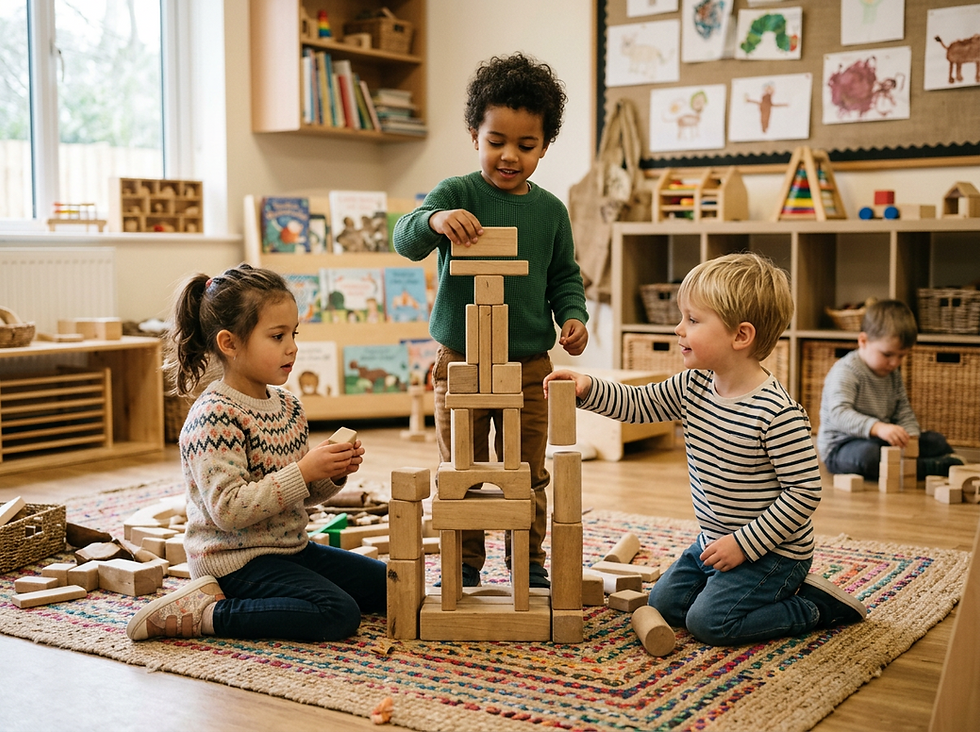
A pretend post office can involve mark making, addresses, sorting, counting, maps, money, weighing parcels, and social language. A water tray can teach capacity, prediction, comparison, cause and effect, and new vocabulary. A block area can build spatial reasoning, planning, balance, measurement, and teamwork.
The difference lies in intent.
Adults should know the learning possibilities. They should also allow children’s ideas to shape the direction.
A strong play-based task has:
a clear purpose
flexible ways to take part
rich materials
useful language
enough time
chances to repeat
room for challenge
Challenge might mean a harder problem, a new tool, a different role, or a question that pushes thinking.
For example, after children build a ramp, an adult might ask, “How can we make the car travel farther?” Children may raise the ramp, change the surface, use a heavier car, or test distance. That is science in a form many children can access.
The learning is real.

How to make play more inclusive in practice
Inclusive play doesn't require expensive resources. It needs careful choices.
Start with one area. Watch who uses it, who avoids it, and who controls it. Then adjust.
Try these steps.
Remove one barrier
If children cannot reach materials, lower them. If noise is a problem, add a quieter version nearby. If a game relies on speech, add picture cards or clear props.
Add more than one way to respond.
Let children speak, point, build, draw, move, match, act, or choose. Keep the learning aim clear, but vary the ways they respond.
Use real and familiar materials.ls.
Children often play more deeply with objects they recognise. Menus, empty food packets, fabric, keys, bags, maps, brushes, pots, and safe household objects can spark richer play.
Rotate with purpose
Do not change everything at once. Keep familiar items for security. Add one or two new objects to extend thinking.
Plan for communication
Add key words, symbols, signs, or sentence starters. Use the same words during play, so children hear them in context.
Notice who gets left out
Watch patterns. Some children may always be assigned “baby”, “customer”, or “helper”. Some may never get the high-status roles—step in when needed.
Value process over display
A perfect craft on the wall may show adult control. A messy model may show planning, testing, and persistence. Look for the thinking.
These steps work in schools, early years settings, and home education. The scale may change. The principle stays the same.
What success looks like
Inclusive play is working when more children join in without being pushed.
You may see children use more language, communicate more easily, participate more easily, and use materials to learn more clearly through signs, objects, gestures, or pictures. You may see longer focus. You may see fewer conflicts because the space and roles make sense. You may see children choosing challenges they once avoided.
You may also see quieter signs:
a child watches first, then adds one block
a child copies a peer’s action
a child returns to the same task over several days
a child uses a new word during play
a child accepts a small change in routine
a child asks another child to join
These moments count.
Progress is not always loud.
Play makes education more human.
Education becomes more inclusive when children don't have to prove they can learn one approved way before they are allowed to belong.
Play opens the door wider. It gives children movement, choice, language, culture, sensory access, social practice, and real challenge. It helps adults see strengths that formal tasks can miss.
The next step is simple. Choose one play area or one routine this week. Watch who participates with ease and who doesn't. Change one thing so more children can enter, contribute, and succeed.
That is where inclusive education starts.


Comments